01 · Context
One ecosystem needs more than one form of AI.
TikTok One already contains AI capabilities across inspiration search, creator collaboration, creative production, campaign delivery, and reporting. Yet existing workflows still move unevenly between traditional interfaces and AI interactions.
The workshop started from a product problem rather than an event theme: different tasks require different levels of autonomy. A multi-step campaign goal may benefit from an Agent that owns the workflow, while an in-context rewrite or review should help immediately without taking users away from their work.
02 · The design question
How should AI-native Agents and embedded Lite Agents coexist?
AI-native Agent
Owns complex, goal-driven work across multiple steps and modules.
Lite Agent
Accelerates one bounded decision inside the interface already in use.
03 · Insight 01
AI-native Agent ≠ Lite Agent.
The distinction is not about model intelligence. It is about the relationship between the AI, the task, and the interface.
04 · Insight 02
AI should disappear into the workflow.
A Lite Agent should not feel like a smaller chatbot placed beside the product. Its value comes from appearing exactly where the user needs help, preserving context, and returning control immediately.
Inline, not adjacent
Place assistance inside the task instead of opening a separate conversation.
Do not interrupt
Keep the page, filters, selections, and scroll position intact.
Context is the entry point
Use the current creator, brief, project, or asset so users do not repeat setup.
Patterns should repeat
Make review, regenerate, apply, and escalation behaviors consistent across features.
05 · Insight 03
Trust comes from controllability.
The Project Review Lite Agent made this principle concrete. Trust did not come from presenting the model as more capable; it came from making every recommendation inspectable, reversible, and optional.
Make this project brief clearer?
The suggestion preserves the original intent while making the requirements more actionable for creators.
The user stays in control because AI proposes a change; it never silently becomes the source of truth.
06 · Behind the workshop
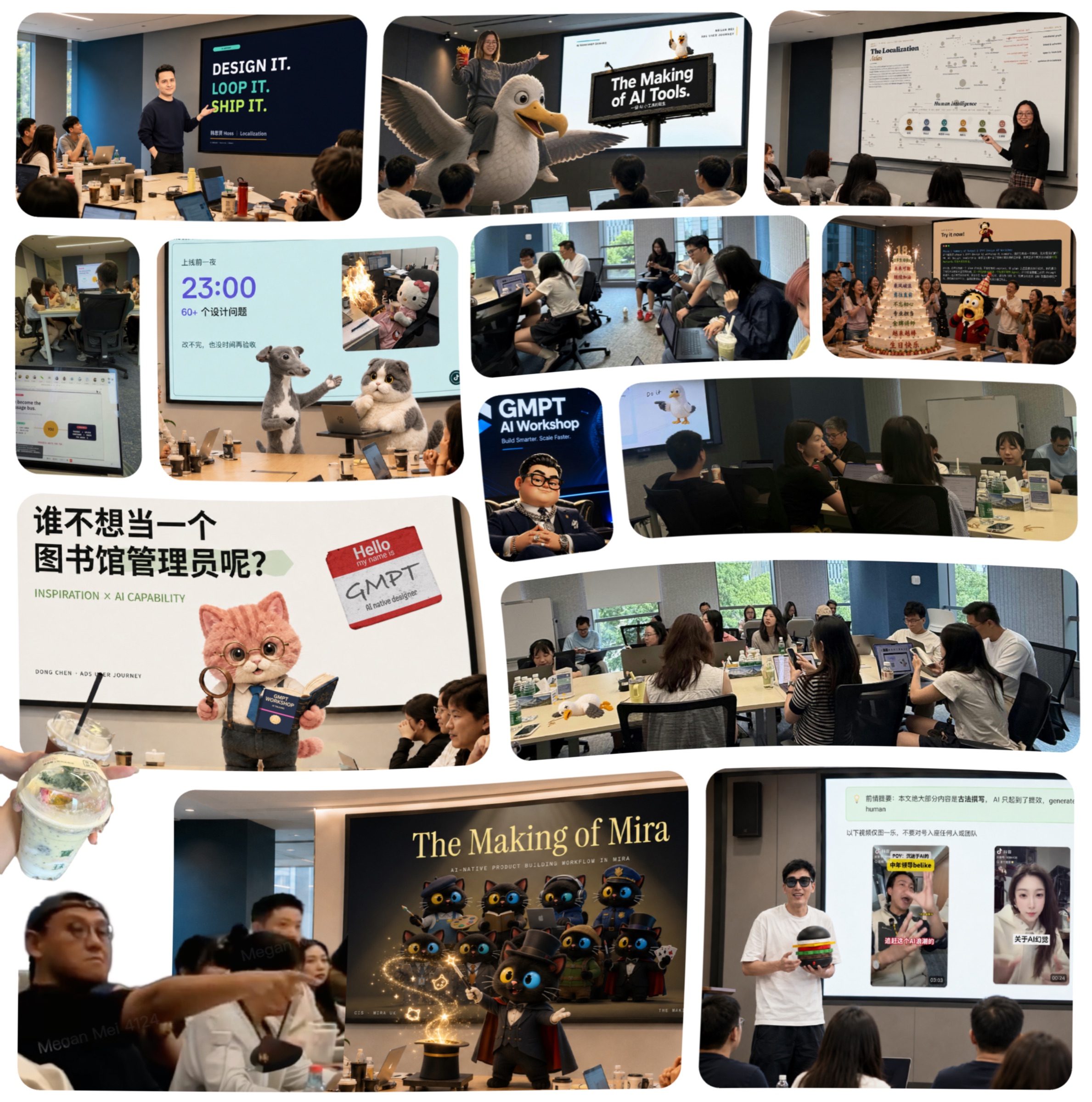
A short path from discussion to a shared interaction model.
07 · Reflection
From one assistant to an ecology of AI interactions.
This workshop changed the way I think about AI-native products. The strongest experience is not always the most autonomous or conversational. It is the one that gives the right form of intelligence the right amount of responsibility at the right moment.